The Broken Airman
The Broken Airman marks a passage in my practice, a movement from representing the view from the cockpit to examining the person within it. In the end, it is not about what breaks, but about what we choose to rebuild.
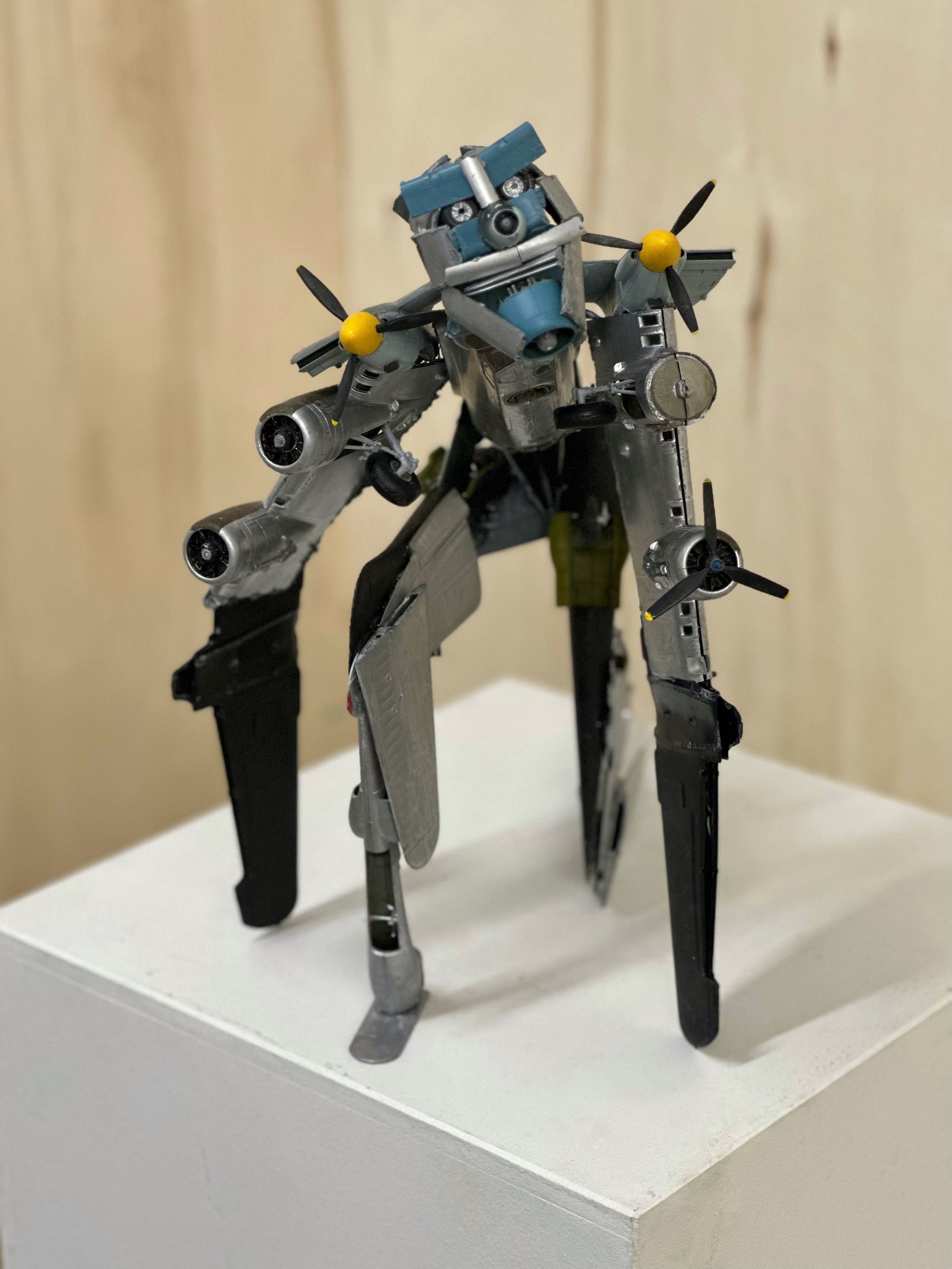
The Broken Airman is a sculptural exploration of identity, fracture, and reconstruction. It emerged from a period of transition, a shift away from the cockpit and toward the studio, and reflects the quiet, internal recalibration that follows when a defining role changes.
For twenty-five years, aviation structured my life. It shaped my perspective, my discipline, and the way I understood space and responsibility. When that chapter altered, I began to consider what remains when the uniform comes off. Who are we when the title falls away? What carries forward, and what must be rebuilt?
This early iteration of The Broken Airman is constructed from model aircraft parts, fragments of miniature fuselages, wings, propellers, and structural components. These are objects designed to replicate real machines at a reduced scale. They carry the language of aviation, but in a delicate form. Reassembled into the suggestion of a human figure, they create a body made from the very machines that once defined it.

The material choice is intentional. Model aircraft are associated with fascination, aspiration, and early imagination, the beginnings of flight as an idea. Yet they are also fragile. They break easily. Their components snap, detach, scatter. In this sculpture, those fragments are not discarded; they are reconfigured. The break becomes part of the structure.
The figure itself is neither whole nor collapsed. It stands in a state of tension, incomplete, exposed, yet upright. Gaps remain visible. Seams are not concealed. There is no attempt to disguise the fracture. Instead, the piece acknowledges it as a necessary stage of transformation.
While rooted in aviation, The Broken Airman extends beyond the pilot’s experience. It speaks to anyone who has undergone a transition, through a career change, personal loss, injury, or reinvention. We often construct identity from the roles we inhabit. When those roles shift, we are confronted with the delicate architecture beneath them.

There is also an inversion at play. Aircraft are engineered for strength, endurance, and aerodynamic efficiency. Here, their miniature counterparts form something vulnerable and human. The machine becomes the body. The mechanical becomes emotional.
Importantly, this work is not about failure. It is about continuity. Aviation itself is built on iteration, test, fracture, redesign, and reinforcement. The sculpture reflects that same principle. Broken does not mean ended. Its adaptation.